How to Start an Office Ping Pong League That Actually Lasts
Most office ping pong leagues die at week six. Not because people stopped liking ping pong, but because the league was designed like a tournament instead of a habit. Here is the playbook that keeps a league alive past month two, whether you run it on paper, a spreadsheet, or an app.
Step 1: Choose a ladder, not a bracket
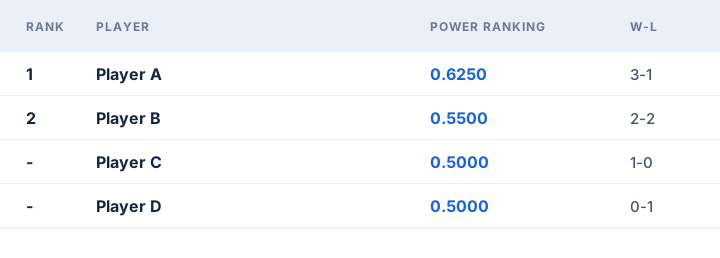
A bracket is a great party and a terrible league. Half your players are eliminated on day one, and the whole thing needs everyone free in the same week. A ladder or open challenge format is the opposite: anyone can play anyone, whenever both are free, and every match counts. Busy week? The league does not care. That resilience is the single biggest predictor of whether your league survives the quarter.
Step 2: Write five rules, not fifty
- Matches are best of 3 or best of 5 games. Games to 11, win by 2.
- Anyone may challenge anyone. A declined challenge is fine; a dodged rival becomes office lore.
- The loser records the result. The winner confirms it. Only confirmed matches count.
- Standings come from the record, never from a person's opinion.
- Disputes get replayed. Nobody argues with a rematch.
The loser-records rule sounds backwards and is the best rule on this list. Winners brag, losers are accurate.
Step 3: Use a ranking people can trust
Win percentage fails the smell test fast: whoever farms the newest players floats to the top. What you want is an opponent-weighted rating, where beating strong players moves you up a lot and beating beginners barely moves you at all. Chess solved this decades ago with ratings like Elo, and college sports use similar strength-of-schedule ratings. The math matters less than the property: the board should reward who you beat, not how often you play weak opponents. When the board has that property, your best player is on top, everyone believes it, and the number two spends lunch plotting an upset. That tension is the fuel the league runs on.
Step 4: Make the board impossible to ignore
A league lives on visibility. Whatever you use, the standings need to be one tap or one glance away for every player: a link in the team channel, a page open on the breakroom TV, a phone app on the table. If checking the board takes more effort than playing a game, the board loses.
Step 5: Lower the friction of recording to near zero
Every step between "we just played" and "it is on the board" is where leagues leak. The winning setup is: record the match at the table, from a phone, in under thirty seconds, with the opponent confirming on their own phone. If recording means finding a laptop, opening a sheet, and remembering the tab, half your matches will never be recorded, and the standings will drift away from reality.
Step 6: Schedule one ritual per week
Leagues survive on one recurring anchor: Ladder Hour on Thursday afternoons, Friday lunch challenges, whatever fits your office. One hour where playing is socially default. Matches played outside the ritual are bonus; the ritual guarantees the league never has a zero week.
Step 7: Let new people enter mid-season
The classic league killer is "join us next season". A good ranking system makes seasons unnecessary: a new player can join in week seven, get rated within a handful of games, and slot into the standings fairly. Every new hire is fresh blood for the league instead of an audience member.
The two-month test
If your league still has ten confirmed matches a week in month two, you have a real league; it will run for years. If it faded, it was almost always one of three causes: a bracket instead of a ladder, standings nobody trusted, or recording friction. All three are design problems, and all three are fixable.
Frequently asked questions
How many people do you need?
Five or six regulars sustains weekly play. Past ten players, prefer a rating-based board over a rigid ladder so nobody queues to play.
Ladder or bracket?
Ladder, always, for the ongoing league. Save the bracket for a one-day launch or holiday tournament; a bracket eliminates most of the office in week one.
Can people join mid-season?
With a rating system, yes, any week: new players start neutral, get rated in a handful of games, and slot in fairly. Seasons and resets are what make joining awkward.
What equipment does a league need?
The table you already own, a bucket of decent 3-star balls, and a visible standings board. Paddles from home beat shared paddles within a month.
Start your circle in five minutes
Breakroom Battles gives your office or club a private circle with a live board, thirty-second match recording from any phone, opponent-confirmed results, and a Power Ranking that rewards beating the best. Free for players, no season resets, and your history follows you.
Create your free circleGrab a paddle, write the five rules on the wall, and challenge the person who thinks they are the best in the office. Every great league starts with exactly one match.