Ping Pong Ladder System Explained: Rules, Challenges, and Rankings
The ladder is the oldest office ranking format for a reason: it needs one sheet of paper and one rule. Everyone gets a rung; beat someone above you and you take their spot. This guide covers the exact rules that make a ladder work, the house rules that stop it from stalling, and when a rating-based board beats a ladder outright.
The core rules of a ping pong ladder
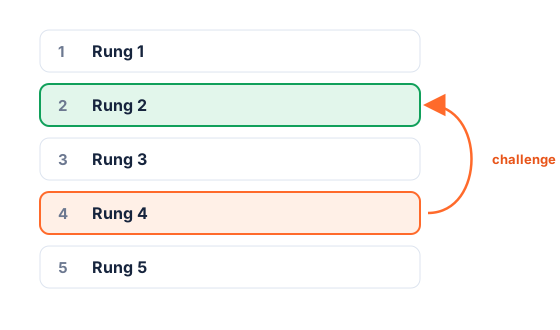
- One rung per player. The list is the ranking. New players join at the bottom.
- Challenge upward, within reach. A player may challenge anyone up to 3 rungs above them. Unlimited-range challenges collapse into everyone queueing for the top seat.
- Winner takes the higher rung. If the challenger wins, the two players swap. If the defender wins, positions hold.
- Defends are mandatory. A challenged player has 5 working days to play or they forfeit the rung. This single rule keeps the ladder alive.
- One live challenge per player. You cannot stack three challenges and blockade a rival.
How to seed a new ladder
Two workable options. Random seeding is fair and takes zero effort, but expect a month of churn while the order sorts itself. Faster: run a one-day launch tournament and seed the ladder from the results. You get a kickoff event and a credible starting order in one afternoon.
House rules that prevent the three classic ladder failures
Camping
The number one player stops accepting challenges and retires undefeated on paper. Fix: mandatory defends with a forfeit clock, plus one rung of weekly decay for anyone with no matches in 14 days.
Bottleneck at the top
Ten people can only climb one rung at a time, so the ladder processes exactly one meaningful result per pairing per week. Fix: none, really. This is structural. It is the main reason bigger groups outgrow ladders (see the alternative below).
New player purgatory
A strong new hire enters at the bottom and needs two months of scheduled challenges to reach their level. Fix: allow a placement window, e.g. a new player's first three challenges may target any rung.
The alternative: a rating-based board
A ladder is a ranking without a rating: your rung says you are above Dave, but not by how much, and you can only prove anything against adjacent rungs. A rating-based board removes the restrictions: play anyone, anytime, in any order, and an opponent-weighted rating turns every result into movement. Beating the office champion moves you a lot; farming beginners moves you barely at all. Everyone starts at a neutral 0.5000 and the board sorts itself within a dozen matches each, with no challenge queue and no camping, because there is nothing to camp.
That is the model Breakroom Battles runs: record any match from your phone, your opponent confirms it, and the Power Ranking reorders the board. The ladder's social core, challenges, survives as an optional feature instead of a bottleneck.
Frequently asked questions
How does a ping pong ladder work?
Every player holds a rung on a ranked list. You challenge someone up to 3 rungs above you; win and you swap places, lose and nothing changes. Over weeks the list converges on true playing strength.
How do you seed a new ladder?
Randomly (fair, slow to converge) or from a one-day round robin or bracket (fast, doubles as a launch event).
How do you stop camping at the top?
Mandatory defends on a 5-day forfeit clock, plus inactivity decay of one rung per week after 14 idle days.
When is a ladder the wrong format?
Past roughly 10 players, or any group that cannot schedule matches reliably. The challenge bottleneck throttles play; a rating-based board lets everyone play in parallel.
Skip the paper ladder
Breakroom Battles gives your office a live board with phone-first match recording, opponent-confirmed results, and a Power Ranking that rewards playing up. Ladder-style challenges included, bottleneck not. Free for players.
Start your office leagueRelated: the full office league playbook, the printable rules sheet, and how rating systems compare.