Ping Pong Rating Systems Explained: Win Percentage vs Elo vs Strength of Schedule
Every league needs to answer one question: who is actually the best? The system you pick decides whether your leaderboard earns trust or arguments. Here are the three families of rating systems, what each gets right, and where each one breaks.
Win percentage: simple, and wrong within a month
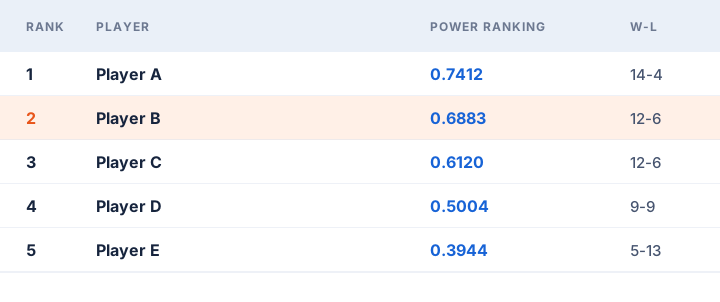
Sort players by wins divided by games. It takes one spreadsheet column, everyone understands it, and it fails the same way in every league: it rewards choosing weak opponents. The new hire farmer goes 9-1 against beginners and sits above your best player, who is 12-6 against killers. Both players can read the board and both know it is wrong. Win percentage also cannot handle uneven schedules, which describes every casual league ever: some people play 40 matches, some play 6.
Elo: the chess answer
Elo, the system chess made famous, fixes the core problem. Every player carries a number; when you win, you take points from your opponent, and the amount depends on the gap between you. Beat someone far above you and you gain a lot. Beat someone far below you and you gain almost nothing. Over time ratings converge toward true skill, which is why versions of Elo run everything from chess to competitive video games.
Elo's weaknesses in a small league are practical. It is path-dependent: the order of results changes the outcome, so early ratings swing wildly. New players start at a provisional number that takes many games to settle. And it never revisits the past: if the person you beat in week one turns out to be a shark, Elo gives you no credit retroactively.
Strength of schedule: the college sports answer
The third family solves the whole season at once instead of updating game by game. Given every result, it asks: what set of ratings best explains all of these outcomes together, weighing each win by the strength of the opponent? College sports rankings work this way. The elegant part is that it is retroactive by nature: when the player you beat keeps winning, your own rating rises, because your win got more impressive. Order of games does not matter, and uneven schedules are handled by construction.
What we use: an improved rating, on a 0 to 1 scale
Breakroom Battles uses the strength-of-schedule approach, recomputed across the whole board after every confirmed match. We call it the Power Ranking, and it reads as a decimal: everyone starts at 0.5000, strong players drift toward 1, and a rating only moves when a confirmed result justifies it. Two properties matter in practice:
- It cannot be farmed. Padding wins against beginners barely moves you. Beating your office champion moves mountains. The board rewards courage, not scheduling.
- Rank and rating stay distinct. Your rank is your position on the board (#3). Your Power Ranking is the decimal (0.6231) that produced it. When both are whole numbers, people confuse them; the decimal makes the difference visible at a glance.
Side by side
| Win percentage | Elo | Strength of schedule | |
|---|---|---|---|
| Rewards beating strong players | No | Yes | Yes |
| Handles uneven schedules | No | Mostly | Yes |
| Retroactive credit | No | No | Yes |
| Runs in a spreadsheet | Easily | Painfully | Not realistically |
Frequently asked questions
What is the best rating system for an office league?
An opponent-weighted, strength-of-schedule rating. It has the one property a self-scheduled league needs: the board rewards who you beat, not how often you beat up beginners.
What does the 0.5000 number mean?
Neutral. Ratings run 0 to 1; everyone starts at 0.5000 and moves as confirmed results come in. Your rank is your position on the board; the decimal is the strength estimate behind it.
How many games until my rating is accurate?
Ten to fifteen confirmed matches against varied opponents. It exists from game one and sharpens as your opponent web grows.
Can a rating go down if I do not play?
Not directly, but it can move when your past opponents' ratings move, because your results are re-weighed against their updated strength. That retroactive credit is a feature: beating someone who later turns out to be great counts properly.
Get the improved rating without the math
Breakroom Battles computes the Power Ranking for your office or club automatically: record a match from your phone, your opponent confirms it, and the whole board updates. Free for players.
Start your league freeWant the bigger picture? Read how to start an office league that actually lasts, or see the league spreadsheet template if you are set on running the math yourself.